
Soldaten und Matrosen / Soldiers and Sailors
Soldat (Posten)
Felddienstuniform Sommer (FDU)
Field uniform Summer
Grenztruppen

Gefreiter (Postenführer)
Felddienstuniform Sommer (FDU)
Fielduniform Summer
Grenztruppen

Soldat
Drillichiform
Grenztruppen

🇬🇧 Border Troops
The German Border Police and later the Border Troops were responsible for securing the state borders of the SBZ/GDR across a total length of 2,236 km (including 1,378 km along the inner-German demarcation line) and monitoring the barrier facilities to prevent illegal border crossings; in the event of war, their role was to defend the border militarily.
Border control in the GDR remained under the authority of Soviet units until 1955. In light of the high number of refugees fleeing the former Soviet Zone of Occupation (SBZ), the Soviet Military Administration deemed it necessary as early as November 1946 to establish and arm the German Border Police. By 1948, the force which had grown to around 10,000 men, was garrisoned and given military training. The Border Police (renamed Border Troops / Grenztruppen from 1974) was temporarily placed under the jurisdiction of the Ministry of the Interior or the Ministry for State Security (MfS), but following the construction of the Berlin Wall, it was assigned to the Ministry of National Defence. Its powers were most recently set out in the "Border Act" of 25 March 1982.
After the construction of the Berlin Wall, the Border Police had a strength of 50,000 men. In addition, around 2,000 "voluntary assistants to the border troops" helped monitor the border area once a month for a twelve-hour shift. Originally, the 18-month military service with the Border Troops was based on a voluntary principle. However, authorities later shifted towards selecting strictly vetted conscripts, giving the Border Troops the character of a military elite. Its commanders were Hermann Rentzsch (1948/49), Josef Schütz (1949-1952), Richard Smolosz (1952/53), Heinrich Garthmann (1953â-1956), Paul Ludwig (1957-1960), Erich Peter (1960-1979), Klaus-Dieter Baumgarten (1979-1990), and Dieter Teichmann (1990).
Increasing perfectionism defined the border regime. In May 1952, modeled on the Soviet system, a five-kilometre-deep restricted zone, a 500-metre-wide protective strip, and a ten-metre-wide control strip were established in front of the actual border. At the same time, the western border was closed across both land and waterways. Furthermore, during Operation "Vermin" (Aktion Ungeziefer), led by the MfS, over 8,000 residents in the border region were relocated, with a further 3,000 relocated during Operation "Consolidation" (Aktion Festigung) in September 1961. At Soviet insistence, a "strict border regime" was to be implemented, leading to the installation of the first landmines. Five years later, the SED leadership expanded the barrier facilities into a "modern border". Depending on the terrain, this included barbed-wire fences, some electric wire-mesh fences, reinforced concrete walls, anti-vehicle trenches, tripwires, minefields, automatic spring-gun devices, light barriers, as well as acoustic and electric warning systems. Furthermore, 715 watchtowers, underground bunkers, dog-run facilities, patrol roads, and a communications network were installed. For the period between 1988 and 2000, plans were made to modernise the border with microwave and infrared technology; the material alone was estimated at 257 million Marks.
However, the single most important containment measure was the construction of the Berlin Wall. From the outset of their duties, the Border Troops operated under the directive to use firearms if necessary to stop "border violators". This placed a severe burden on the mostly young border guards.
The inspection of passenger traffic at border crossing points (GÜSt) was not the responsibility of the Border Troops, but of the Passport Control Units (PKE) of the MfS. Although they wore Border Troop uniforms and were formally subordinate to the border commander, they were actually under the control of the MfS. Their higher pay and different regulations granted them a special status, which strained relations with members of the Border Troops, especially as the notoriously harassing behavior during checks was also attributed to the latter's reputation.
The monitoring of cross-border goods, foreign currency, and gift traffic fell to the Customs Administration, founded in 1962. It had developed out of the Office for Customs and Control of Goods Traffic (AZKW), created in 1950. It exercised regulatory and police powers to a significant degree.
In January 1990, the GDR government ordered a 50% reduction of the Border Troops; on 30 June 1990, immediately prior to the monetary union, border controls between the GDR and the Federal Republic of Germany were abolished.
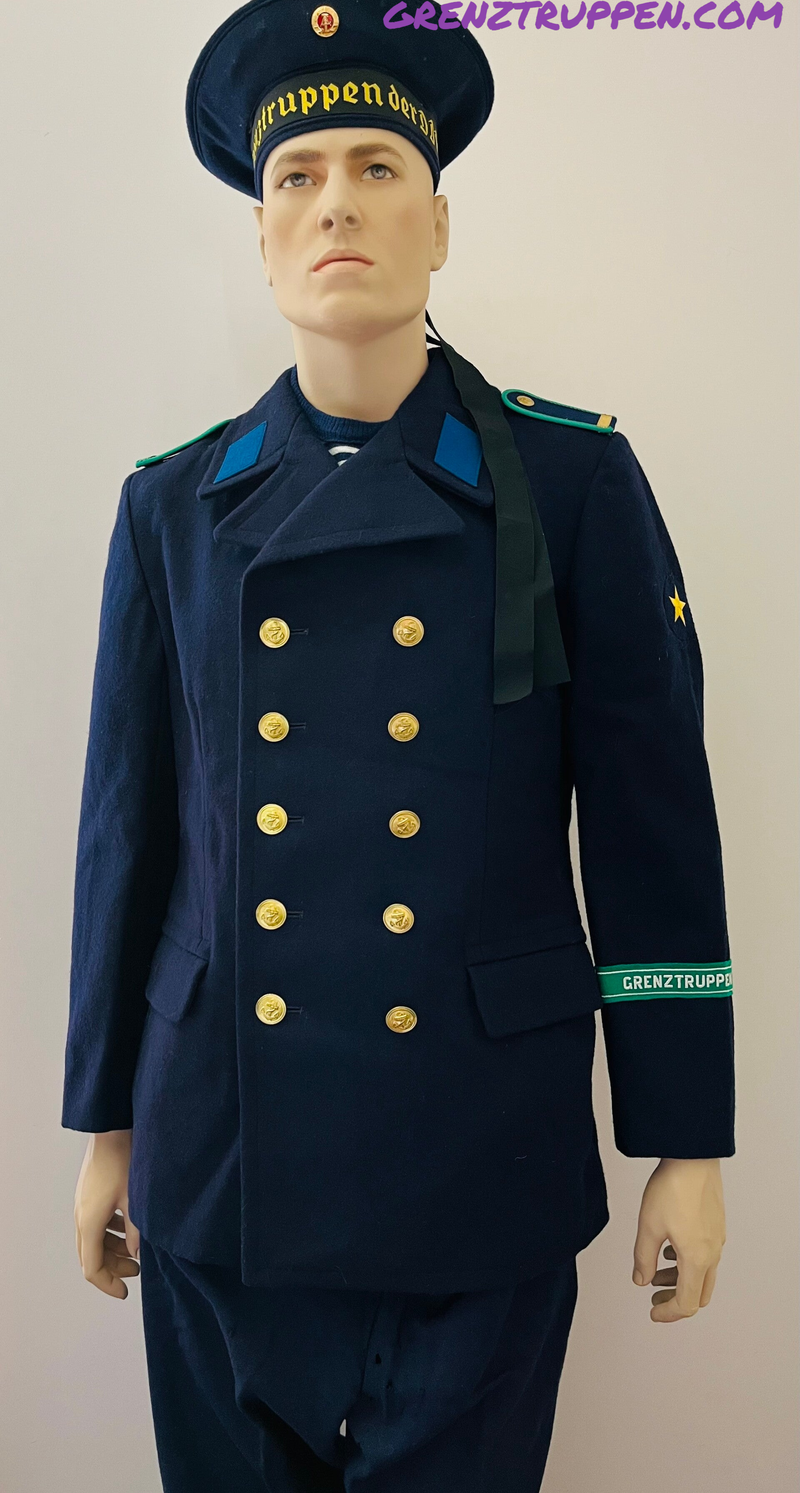
Obermatrose
Ausgangsuniform (Übergang)
Walking out uniform
Grenztruppen Bootskompanien
Gefreiter
Ausgangsuniform (Übergang)
Walking out uniform (transitional)
Grenztruppen / Grenzflieger (HS-16)

Soldat (Unteroffiziersschüler)
Ausgangsuniform Sommer (vor 1983)
Walking out uniform Summer (before 1983)
Grenztruppen

Gefreiter (Postenführer)
Dienstuniform (Sommer) tragenweise in Berlin
Service uniform (Summer) only worn in Berlin
Grenztruppen

Gefreiter (Postenführer)
Ausgangsuniform (Übergang)
Walking out uniform (transition)
Grenztruppen

Gefreiter (Postenführer)
Dienstuniform (Übergang) Trageweise Berlin
Service uniform (transitional) only worn in Berlin
Grenztruppen

Gefreiter (Postenführer)
Ausgangsuniform (Winter) < 1986
Walking out uniform (winter) < 1986
Grenztruppen

Gefreiter (Unteroffizierschüler)
Ausgangsuniform (Winter) > 1986
Walking out uniform (winter) > 1986
Grenztruppen

Soldat
Ausgangsuniform (Sommer nr. 2)
Walking out uniform (summer)
Grenztruppen

Soldat
Dienstuniform (Übergang) <1976
Service uniform (transitional period) <1976
Grenztruppen

Soldat
Felddienstuniform (70er Jahre)
Field uniform (Seventies)
Grenztruppen

Unteroffiziere und Maate auf Zeit / Non-career NCOs
Unteroffizier (auf Zeit)
Paradeuniform
Parade uniform
Grenztruppen

Obermaat (auf Zeit)
Ausgangsuniform (Sommer)
Walking out uniform (Summer)
Grenztruppen / Bootskompanien

Maat (auf Zeit)
Ausgangsuniform (Übergang)
Walking out uniform (transitional)
Grenztruppen / Bootskompanien

Soldaten / Unteroffiziere auf Zeit
Trainingsanzug / Sportbekleidung
Track suit
Grenztruppen

Unteroffizier auf Zeit
Stabdienstuniform
Staff service uniform
Grenztruppen

Berufsunteroffiziere / Career NCOs
Feldwebel
Paradeuniform
Parade uniform
Grenztruppen

(Berufs) Unteroffizier
(Stab)Dienstuniform (Übergang)
Service uniform (transitional)
Grenztruppen

Feldwebel
Paradeuniform
Parade uniform
Grenztruppen / HS-16

Offiziersschüler / Officer cadets
Offiziersschüler 3. Lehrjahr
Ausgangsuniform (Winter)
Grenztruppen

Offiziersschüler 3. Lehrjahr
Paradeuniform
Grenztruppen

Offiziersschüler 3. Lehrjahr
Ausgangsuniform (Übergang)
Grenztruppen

Fähnriche / Warrant Officers
Stabsoberfähnrich
Paradeuniform
Parade uniform
Grenztruppen / Bootskompanien

Stabsfähnrich
Paradeuniform
Parade uniform
Grenztruppen

Obersfähnrich
Paradeuniform
Parade uniform
Grenztruppen / Grenzflieger (HS-16)

Stabsoberfähnrich / Spiess
Dienstuniform (Übergang)
Service uniform (transitional)
Grenztruppen

Stabsfähnrich
Felddienstuniform
Field service uniform
Grenztruppen (Grenzaufklärer)

Stabsfähnrich
Gewetteruniform
Weather uniform
Grenztruppen (Grenzaufklärer)

Offizieren / Junior officers
Oberleutnant
Paradeuniform
Parade uniform
Grenztruppen Bootskompanien

Oberleutnant
Kleiner Gesellschaftsuniform
'Small' gala uniform
Grenztruppen Bootskompanien

Oberleutnant
Grosser Gesellschaftsuniform
'Big' gala uniform
Grenztruppen

Leutnant
Dienstuniform Winter ab 1986
Service uniform winter from 1986
Grenztruppen

Hauptmann
Paradeuniform ab 1986
Parade uniform from 1986
Grenztruppen / Grenzflieger (HS-16)

Oberleutnant
Felddienstuniform FDU
Field uniform
Grenztruppen

Leutnant
Dienstuniform (Übergang)
Service uniform (Übergang)
Grenztruppen

Oberleutnant
Felddienstuniform (Übergang)
Field uniform (transitional period)
Grenztruppen Berlin

Leutnant
Dienstuniform (Übergang)
Service uniform (Transitional period)
Grenztruppen

Hauptmann
DIenstuniform <1976
Service uniform <1976
Grenztruppen

Weibliche Angehörige / Females
Sportbekleidung
Sport gear
Grenztruppen

Stabsoffizieren /Staff officers
Oberstleutnant
Ausgangsuniform (Übergang) ab 1986
Walking out uniform from 1986
Grenztruppen / Grenzflieger (HS-16)

Oberst
Paradeuniform
Parade uniform
Grenztruppen

Oberst
Paradeuniform
Parade uniform
Grenztruppen


